Nones, not Nuns

For over 50 years, sociologists at the University of Chicago have gathered data about contemporary U.S. society. They use a set of survey questions called the General Social Survey (or GSS). Every year from 1972 to 1994 and every other year since, thousands of Americans take part. Together, their responses give researchers a snapshot of American life. The GSS in 2026 will be very much the same as it was in 1972. The questions change little. This means it's not just a single snapshot; it's a time-lapse.
The questions of the GSS are wide-ranging, but you may know about a few of them in particular: the questions about religious participation and identity. Even more likely, you know the story arising from these handful of questions: the rise of the Nones. As in, the Americans who have disaffiliated from religious attendance and who, if and when surveyed, choose not "Protestant" or "Jewish" or "Muslim" or "Catholic" but "none." Since the 1970s the share of American Christians dropped from near 90% to around 65% today. Now at least a quarter, maybe 30%, of U.S. adults claim no religious affiliation at all. They are the Nones, all 100 million of them.
But who are the Nones? Can we paint a more vivid picture? For as prevalent as the term "Nones" is, we actually know very little about them - in terms of sociological data. The GSS and similar surveys conducted by Pew Research and Gallup ask just a handful of questions about religious belief and practice. And there isn't - or hasn't been - much high-quality data for researchers to say much more than "some numbers are going up and other numbers are going down."
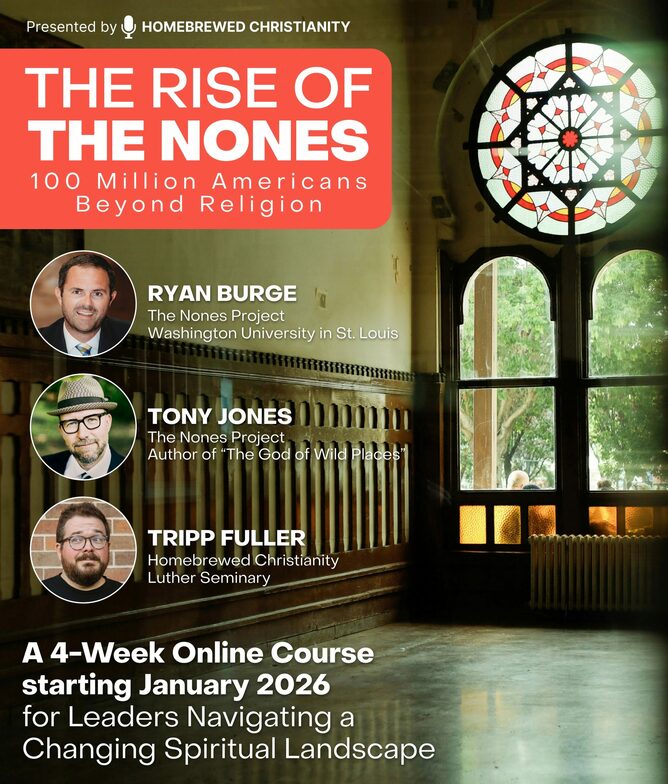
A brand new 3-year study sheds new light, though. Over 15,000 Americans participated, and sociologists and researchers are beginning to share their findings from this mountain of data. Right now, I'm participating in a four-week webinar with Dr. Ryan Burge and Dr. Tony Jones, the people behind it. It is still early days. This data will be studied by many more for many years to come. But they offer an introduction...
the Four Types of Non-Religious Americans
Nones in Name Only (NiNOs) or "Christian but not Catholic": These Nones are actually highly spiritual and fairly religious. They aren't really Nones, but they represent about 1 in 5 Nones. Many American Christians don't know what "Protestant" means, and so they don't claim it when asked. They are "Jesus followers." They have "a relationship not a religion." In other words, Nones have been overcounted.
Spiritual But Not Religious (SBNRs): These Nones are, as you can guess, fairly spiritual but hardly religious. Actually, they're not terribly spiritual in practice, even if they do claim spirituality as part of their identity. Over one-third of Nones, 36%, fit in this category, and it might be best, after further study, to divide it into two to give a clearer picture.
"Dones": These Nones happily do not believe in God. They don't pray or attend any kind of worship, and they feel no yearning to change that. They are a third of Nones and 10% of Americans as a whole. There are more Dones than there are Mainline Protestants. Zion is a Mainline Protestant church. Dones alone outnumber us. Let that sink in.
Zealous Secularists: These are the youngest Nones, and they're actually a bit more spiritual and religious than Dones. But here's what set this 11% of Nones apart from the rest: over three-quarters of them have "tried to convince someone to leave religion." They aren't content to merely walk away, like Dones or even SBNRs in their way. Instead, they are trying to persuade others to do the same. Three percent of all Americans are Zealous Secularists.
+
I'm curious to learn more. I've watched just one of the four webinars so far, and I've purchased but haven't yet read several of the panelists' books. Maybe you have other stronger feelings than "curious," but that's me. Once upon a time, there were only 12 Christians in the whole world! More than half of Nones are still interested, still engaged in some way. Jesus still polls well, even if church or Christians don't.
As Zion puts new intention and a new strategic plan toward engaging young people, many of whom are Nones, I trust that God is already at work. Are we courageous, loving, and wise enough to build relationships with our neighbors, Nones and all? And discover along the way God's unique calling to Zion, for their sake? Yeah, I really think so. Don't you?
Thanks and peace,
Pastor Clark